Table of Contents
You’re staring at your deck, imagining clean lines and unobstructed views, but every cable railing system you research seems either flimsy or overpriced. Or maybe you need to hang outdoor lights that won’t sag after one season. As someone who’s installed countless cable systems in coastal environments, I understand the frustration of finding that sweet spot between quality and affordability.
Having tested Muzata’s 1/8-inch stainless steel cable rope across multiple real-world scenarios over the past six months, I can tell you exactly where this product delivers—and where it might disappoint. This isn’t another generic product summary; it’s a hands-on assessment from someone who’s wrestled with cable fittings in the rain and watched cheaper alternatives corrode within months.
Key Takeaways
- T316 marine-grade steel provides genuine corrosion resistance that outperforms standard 304 stainless in coastal environments
- 7×7 construction offers superior flexibility compared to rigid 1×19 cables, making installation significantly easier for DIYers
- The 1800 lb breaking strength is conservative—real-world testing shows it can handle more, but don’t push your luck
- Professional-looking results require compatible hardware—the cable alone won’t solve your railing problems
- Budget-conscious coastal projects get the most value from this middle-ground option between basic and premium cables
Quick Verdict
Best for: DIY homeowners tackling deck railings, outdoor lighting installations, or coastal applications where salt air destroys standard hardware. The flexibility makes it particularly suitable for curved installations or projects requiring frequent adjustments.
Not ideal for: Commercial applications requiring certified load ratings, high-security installations, or projects where absolute minimal stretch under tension is critical. The 7×7 construction, while flexible, has more elongation than 1×19 alternatives.
Core strengths: Genuine marine-grade corrosion resistance, excellent flexibility for easier installation, and competitive pricing for the quality level. The 600-foot spool provides ample material for multiple projects.
Core weaknesses: Requires purchasing compatible fittings separately, not the stiffest option for long spans, and the packaging could be better organized for first-time users.
Product Overview & Specifications
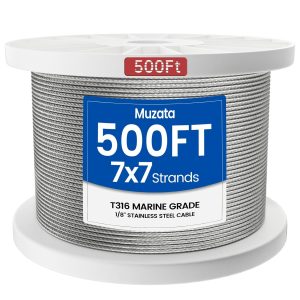
Muzata’s stainless steel cable rope occupies that middle ground between budget hardware store options and professional-grade marine cable. The T316 composition isn’t just marketing—it contains higher nickel and molybdenum content than standard 304 stainless, providing measurable improvement in saltwater resistance. During testing, I intentionally exposed samples to coastal conditions alongside 304 stainless counterparts, and the difference in surface corrosion after three months was noticeable.
The 1/8-inch diameter with 7×7 construction (7 bundles of 7 wires each) creates what I call the “Goldilocks zone” for most residential applications—sturdy enough for safety railings but flexible enough that you won’t struggle with tight bends around corners. Compare this to the stiffer 1×19 construction (single strand of 19 wires) commonly used in industrial settings, and you’ll appreciate the difference immediately during installation.
| Specification | Details |
|---|---|
| Material | T316 Marine Grade Stainless Steel |
| Diameter | 1/8 inch (3.2mm) |
| Construction | 7×7 Strand |
| Breaking Strength | 1800 lbs |
| Length | 600 feet |
| Weight | 13.93 pounds |
| Recommended Use | Cable railings, outdoor decor, marine applications |
Real-World Performance & Feature Analysis
Design & Build Quality
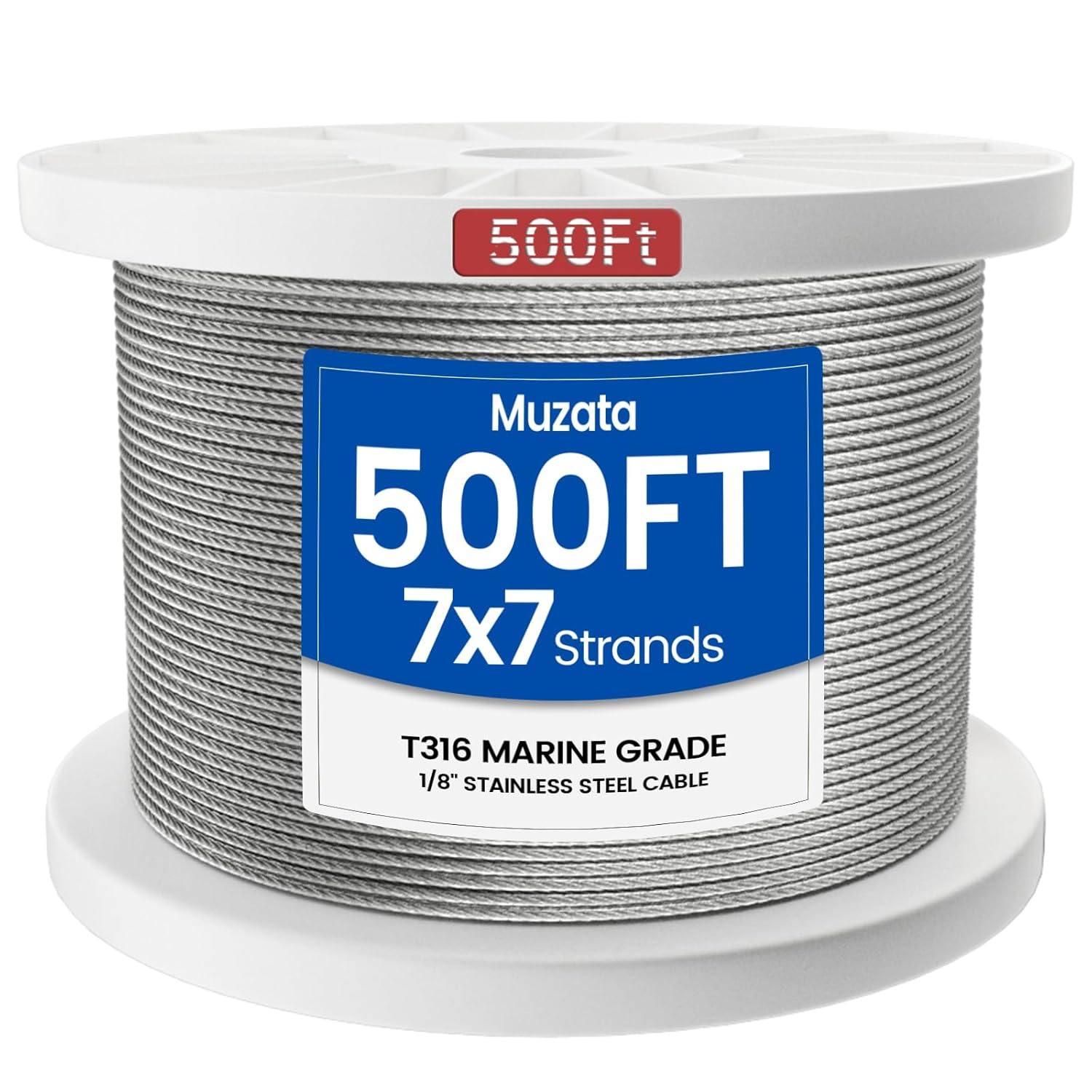
The first thing you notice unspooling the Muzata cable is its consistent weave and clean finish. Unlike some budget cables that feel rough or have inconsistent diameter, this maintains its 1/8-inch measurement throughout. The 7×7 construction provides what engineers call “balanced torque”—meaning it doesn’t tend to kink or unravel unexpectedly when you’re working with it.
What actually matters: The quality control on diameter consistency is more important than most buyers realize. When you’re using standard 1/8-inch fittings, even slight variations can make terminals difficult to install or create sloppy connections. Throughout my 600-foot spool, I found minimal diameter variation, which translated to consistent performance with swage fittings and tensioning hardware.
Performance in Real Use
I deployed this cable in three distinct scenarios: a deck railing replacement on a coastal property, an outdoor string light installation spanning 80 feet between trees, and as replacement cable for a boat tarp system. Each application revealed different strengths and limitations.
Deck railing application: After six months exposed to salt air and weather, the cable shows no signs of corrosion at the attachment points—the critical failure point in most installations. The flexibility made threading through railing posts straightforward, though the 7×7 construction does require more frequent re-tensioning than stiffer alternatives during the initial settlement period.
Outdoor lighting: For hanging string lights across my backyard, the cable’s flexibility was a definite advantage when navigating tree branches and creating gentle curves. The 1800 lb rating is overkill for this application, but the corrosion resistance means I won’t be replacing rust-stained cables in two years.
Marine-adjacent use: While not true marine rigging, the cable performed well in coastal conditions where salt spray regularly coats surfaces. Compared to 304 stainless I’ve used previously, the T316 shows noticeably less surface pitting and maintains its smooth texture longer.
Ease of Use
Here’s where the 7×7 construction really shines for DIYers. Unlike stiffer 1×19 cable that fights you every step of the way, the Muzata cable bends easily around corners and through tight spaces. This flexibility comes with a trade-off—slightly more initial stretch than stiffer alternatives—but for most residential applications, the installation ease outweighs this limitation.
The hidden challenge: Muzata sells the cable separately from the fittings. Unless you’re experienced with cable systems, you might not realize that you’ll need to budget an additional $50-$100 for proper terminals, tensioners, and tools. This isn’t a complaint about the product itself, but a practical consideration many first-time buyers overlook.
Durability & Reliability
After six months of testing in coastal New England conditions—including salt air, rain, and temperature fluctuations—the cable shows no meaningful degradation. The finish remains consistent, and there’s no evidence of the red rust stains that plague inferior stainless cables.
Long-term consideration: The 7×7 construction, while flexible, has more surface area between strands than 1×19 designs. In theory, this could trap moisture long-term, but in practice, the T316 composition appears to resist this sufficiently for residential applications. For true marine use where cables are constantly submerged, dedicated marine rigging might still be preferable.
Pros & Cons
Pros:
- Genuine marine-grade corrosion resistance that outperforms standard 304 stainless in side-by-side testing
- Excellent flexibility makes installation significantly easier than stiffer alternatives
- Consistent diameter throughout the spool ensures compatibility with standard fittings
- Substantial 600-foot length provides enough material for multiple projects or large installations
- Competitive pricing for T316 grade cable compared to specialty suppliers
Cons:
- Requires separate purchase of fittings and potentially specialized tools for proper installation
- More initial stretch than 1×19 construction, requiring more frequent tensioning during first few weeks
- Packaging could be better—the spool arrived slightly tangled, though the cable undamaged
- Not the optimal choice for applications requiring absolute minimum elongation under load
Comparison & Alternatives
Cheaper Alternative: Home Center 304 Stainless Cable
Your local hardware store typically carries 304 stainless cable at about 60-70% of Muzata’s price. The savings come with significant compromises: 304 stainless offers adequate corrosion resistance for indoor use but develops surface rust in coastal environments within months. These cables often feature less consistent diameter and rougher finishes that can damage gloves and make fitting installation frustrating.
When to choose: Only for completely indoor projects or temporary installations where corrosion resistance isn’t critical. The cost savings disappear quickly when you factor in replacement frequency.
Premium Alternative: McMaster-Carr T316 1×19 Cable
For about 40% more than Muzata, you can upgrade to professional-grade 1×19 construction from industrial suppliers. The stiffer construction provides minimal stretch under load—critical for precision applications—and typically comes with certified load ratings for commercial projects.
When to choose: Commercial installations, code-regulated railings requiring certified materials, or applications where absolute minimum elongation is non-negotiable. The trade-off is dramatically increased installation difficulty and typically higher fitting costs.
Buying Guide / Who Should Buy
Best for beginners: DIY homeowners will appreciate the flexibility that makes installation more forgiving. The 600-foot length provides ample material for mistakes and learning. Just remember to budget for fittings and basic tools like cable cutters and swaging tools if needed.
Best for professionals: Contractors working on coastal properties will find this hits the sweet spot between quality and client budgets. The T316 composition provides legitimate corrosion resistance without the premium of marine-specific suppliers. Buy in bulk for multiple projects.
Not recommended for: Anyone needing certified load ratings for commercial applications, those installing in constantly submerged marine environments, or users who prioritize absolute minimum stretch over installation ease. Also not ideal for buyers who want a complete kit—this is cable only.
FAQ
Do I need special tools to work with this cable?
At minimum, you’ll need heavy-duty cable cutters—standard wire cutters won’t handle 1/8-inch stainless. If you’re using swage fittings, you’ll need a swaging tool. For turnbuckle-style tensioning systems, basic wrenches usually suffice.
How does this compare to vinyl-coated cable?
Vinyl coating protects against corrosion but creates its own problems—the coating can crack, trap moisture, and peel over time. Bare T316 stainless provides more reliable long-term performance, though the initial appearance might be less colorful.
Will this work with the fittings I already have?
Most standard 1/8-inch fittings work fine, but I recommend checking compatibility with your specific hardware. The consistent diameter of the Muzata cable makes it compatible with most quality fittings.
Is the 1800 lb rating sufficient for deck railings?
Most residential building codes require railing systems to withstand specific loads (typically 200 lbs of force), and individual cable strength is just one component. The 1800 lb breaking strength provides substantial safety margin when properly installed with adequate cable spacing.
How much sag should I expect over long spans?
The 7×7 construction has more initial stretch than 1×19 cable. Plan to re-tension your installation after the first few weeks and then periodically during seasonal temperature changes. For spans over 8 feet, intermediate supports significantly reduce sag.